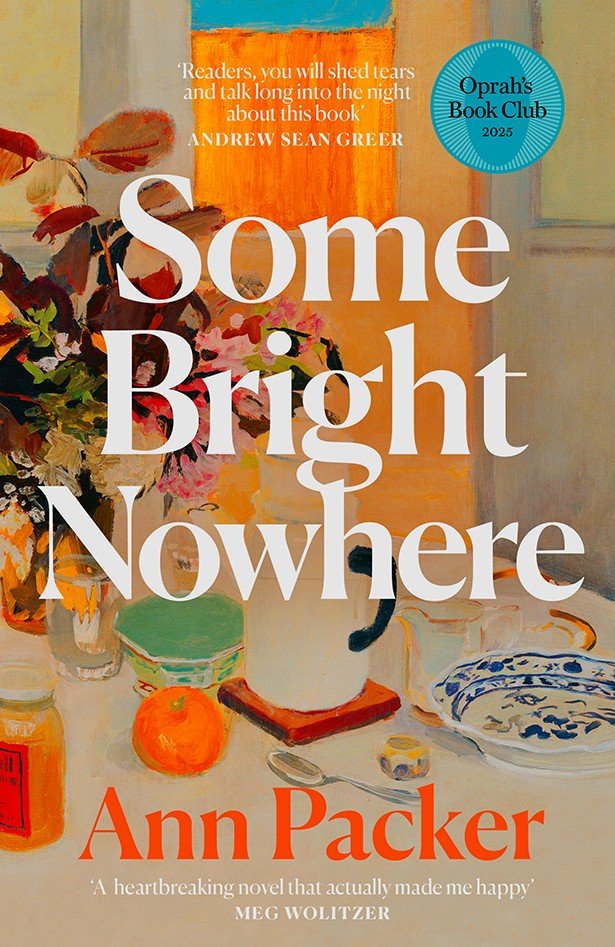
Some Bright Nowhere by ann packer
the financial times 13 february 2026
Claire and Eliot have been happily married for nearly four decades. They live in a quiet town in Connecticut and take idyllic-sounding holidays in Maine. When she was diagnosed with cancer eight years ago, he retired to care for her. And yet, as Some Bright Nowhere begins and Claire decides with her oncologist that further treatment is futile, instead of seeking the solace of her seemingly devoted husband, she asks him to leave. She wants to be cared for by her friends Holly and Michelle.
Ann Packer has said that her latest novel was inspired by a true story: “It blew my mind that you could just expel your spouse because they weren’t exactly right for the job, whatever that was going to be.”
Claire’s decision seems to have been influenced by the example of a friend, Susan, who, when she was told she had only months to live, was cared for by her sisters, daughters and friends — including Claire. Claire explains to her husband: “It’s wanting A . . . rather than not wanting B.”
Packer is the author of three previous novels, most recently The Children’s Crusade (2015), as well as short story collections. Her writing is firmly in Elizabeth Strout territory — in the New England setting of Some Bright Nowhere, and in the compassionate realism of her work overall — and this novel is no poorer for it. An observation Eliot makes about Claire could equally be made about the way Packer approaches writing her characters: “Eliot loved hearing Claire talk about people, her combination of warmth and dispassion.”
Eliot is devastated by his wife’s choice and accuses her of wanting her death to be “pretty”. Later, Claire concedes that possibly she wanted to feel the way she did when Susan died, rather than accepting that this time round, she will be the one dying. She lights up when her friends bring her presents of sleepwear and toiletries, laughing that they have set up a “death spa”.
Eliot reflects on what constitutes caring for a dying person: “What was caretaking, anyway? Could you separate caretaking as a whole from the sum of its parts? Helping, soothing, driving, phoning, cooking, listening, tending, waiting, learning, remembering, deciding, forgoing. A lot of forgoing.”
Intriguingly, Packer’s own husband Rafael Yglesias wrote a 2019 novel called A Happy Marriage about how a long-married couple cope when the wife is diagnosed with cancer. It was Yglesias who suggested Packer give Eliot a space where he could discuss his feelings with male friends — this is where the touching men’s cookery club scenes originate from, and as a result we have more insight into how Eliot feels than Claire has.
Eliot and Claire’s adult children, Josh and Abby, are less than thrilled by the decision. Josh lashes out, calling his father a “benign blob”— finding the root of his mother’s choice in his father’s amenability— whereas Abby, a paediatrician, is more reflective,
reassuring him that there is a rise in “death doulas” who offer a “woman-to-woman connection during a life transition”. In a novel which makes a powerful bid for our empathy, the affluence of almost everybody — with the possible exception of Claire and Eliot’s musician son, Josh — is striking. There is very little discussion of the financial cost of cancer, aside from Eliot’s brief reflection on the admin involved in medical bills. What is significant about Packer’s choice here is that it demonstrates how no one, regardless of material comfort, will be spared the enraging humiliation of dying.
The author is unflinching in describing the physical horrors Claire suffers and fears — she is haunted by the idea of “ascites, fluid filling the abdomen until it was as distended as a balloon”. For all of that, this is not a depressing book, not least because Claire is able to express some autonomy about how she wants to die. Ultimately, Packer conveys that dying well is also about living.
This review originally appeared in the Spectator