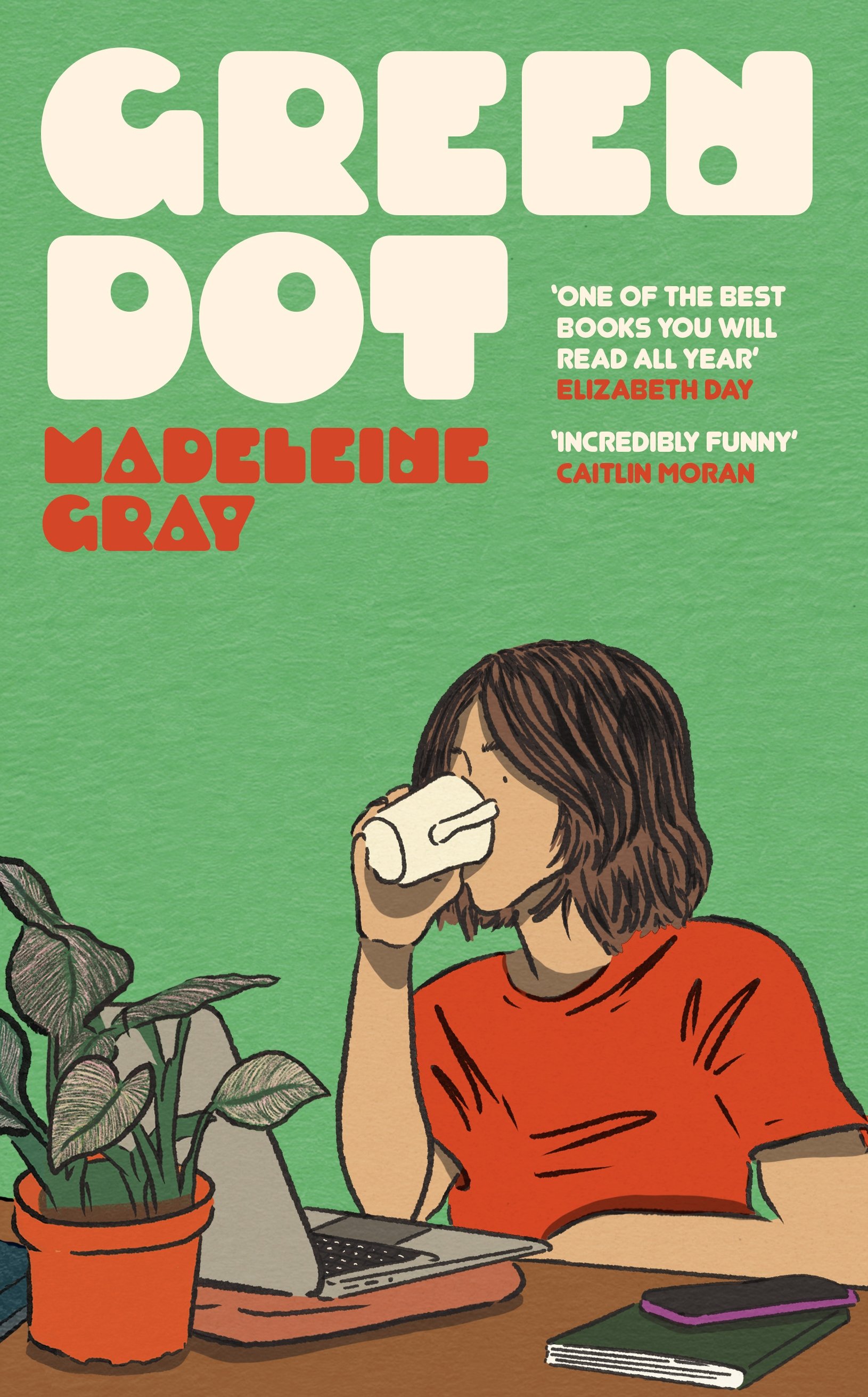
Green Dot by Madeleine Gray

Hera, the heroine of Madeleine Gray’s first novel, is 24, which, as she says, ‘seems young to most people but not to people in their mid-twenties’. She lives in Sydney with her father and their dog and works as an online community moderator, but the contents of her work bag reveal her to be Bridget Jones’s edgier little sister: ‘My wallet, three pairs of underpants, headphones, nine tampons, a travel vibrator, two novels, a notebook, two beer caps, a bottle of sake and a fountain pen.’ She will also inevitably be compared to Hannah from Lena Dunham’s Girls and to Phoebe Waller-Bridge’s Fleabag.

Gray’s writing style is droll but if Hera’s internal monologue sounds gauche and affected, it is useful to remember what the average 24-year-old sounds like. When she tells her closest friends her feelings, she reflects to herself: ‘I’ll speak it now and work out if it’s honest later.’ Her cynical schtick is not always palatable, particularly when she describes a colleague as having ‘the embodied exhaustion of a Holocaust museum tour guide’.
 

Tackle! by Jilly Cooper

Jilly Cooper, queen of the British bonkbuster, has turned her attention to football for her 18th novel. She was inspired after sitting next to Sir Alex Ferguson at lunch one day. She also thanks Kenny Dalglish, Alan Curbishley and ‘my wonderful neighbour’ Tony Adams in her acknowledgements. Her friend, the former home secretary Michael Howard, even took her to a Liverpool match, where she met Steven Gerrard. 

Her legions of fans need not worry, however. We are still in Rutshire, the village Cooper created for her earlier novels; Rupert Campbell-Black, the hero of Riders, Rivals and Mount!, who was allegedly partly modelled on Andrew Parker Bowles, still lives in Penscombe Court, ‘his beautiful, gold Queen Anne house’; and he is still ‘Nirvana to most women’, but now in his sixties and distraught over his wife Taggie’s breast cancer.


Playing Games by Huma Qureshi

Playing Games is Huma Qureshi’s fourth book and first novel. Born in the UK into a family of Pakistani heritage, her previous works include a memoir, How We Met, and a collection of short stories, Things We Do Not Tell People We Love, which featured women of Pakistani origin unable to communicate honestly with the people closest to them. Her memoir told the story of how, after trying Muslim-specific dating websites with no luck, she met and married her husband, a white Englishman who converted to Islam to be with her.  Playing Games seems, on the face of it, a change of direction, barely touching on religion or cultural concerns. It focuses on two sisters in their early thirties living in north London: Hana, a married lawyer, and her younger sister Mira, who works in a coffee shop and lives in a crappy house share while trying to write her first play. Their mother, an art teacher, died 11 years ago, something both sisters are still wrestling with. Hana has fled from any kind of artistic endeavour and runs her life with obsessive control, while Mira is happy to pursue a larger dream. 


Jungle House by Julianne Pachico

Jungle House is not the sultry tropical tale you might expect either from its title or from its vivid, palm-strewn dust jacket. Instead, Julianne Pachico’s third novel concerns AI. This is not immediately obvious, and although there is an appealing directness to the writing, it means that no time is spent setting the scene or allowing readers to get their bearings fully. I could have done with more explication of the circumstances in which a young girl, Lena, comes to live in an AI-controlled house.

At the book’s opening, Lena has her work cut out:

“There’s fishing and mushroom-gathering and swimming in the river. Five days a week are for exercise and two days are for rest. In the orchard there are bananas and guavas, grapefruits and limes.”

Lena has moved out of the main house and is living in the guest hut, or ‘caretaker’s hut’, as she calls it. She refers to ‘Mother’, who these days is ‘angry all the time’, and one could easily assume at first that she is referring to her own mother.


The Collected Works of Jo Ann Beard

Jo Ann Beard has said that one of the stories in this collection, although she does not specify which, took her more than 20 years to write and that there was a gap of eight months – during which she was working on the piece five days a week – between two of its sentences. It is true that her writing is remarkably condensed, not least in ‘Cheri’, the story of a real woman who had a particularly hideous case of terminal cancer (exacerbated by the fact that all pain medication made her vomit). Cheri Tremble contacted Jack Kevorkian, a euthanasia expert sometimes nicknamed ‘Dr Death’, so that he could help her end her life. As she begins to die, Cheri, in Beard’s version, wryly reflects: ‘The fear of dying tonight is nothing… compared to the fear of still being alive tomorrow morning.’

Beard has barely been published in the UK, but her fans include Jonathan Franzen, Sigrid Nunez and Jeffrey Eugenides. Mary Gaitskill has called her ‘a kind of literary celebrity that very few people have heard of’.


Second Self by Chloe Ashby

Chloë Ashby’s thoughtful second novel focuses on fertility and the choices women in their thirties routinely face over motherhood. Cathy, the heroine, is married to Noah, who is around a decade older and has decided he doesn’t want children.

Mothers are everywhere in this book. There is Cathy’s best friend, her sister-in-law and her own widowed mother, Janey. Janey lives alone in Norfolk while Cathy – her only child – is in London; she appears to be slipping into dementia and this story line forms the other main strand of Second Self. Ashby implies that some of Cathy’s indecision over motherhood relates to the effective loss of her own mother to old age and disease.

Ashby writes with great fluency and is very confident in her evocations of Cathy and Noah’s middle-class milieu of Ottolenghi takeaways and almond bellinis. For all Cathy’s material comfort, however, this is not a smug novel, or a satire on smugness. There is plenty to fear here: infant mortality, Alzheimer’s, marital breakdown, ageing, death.